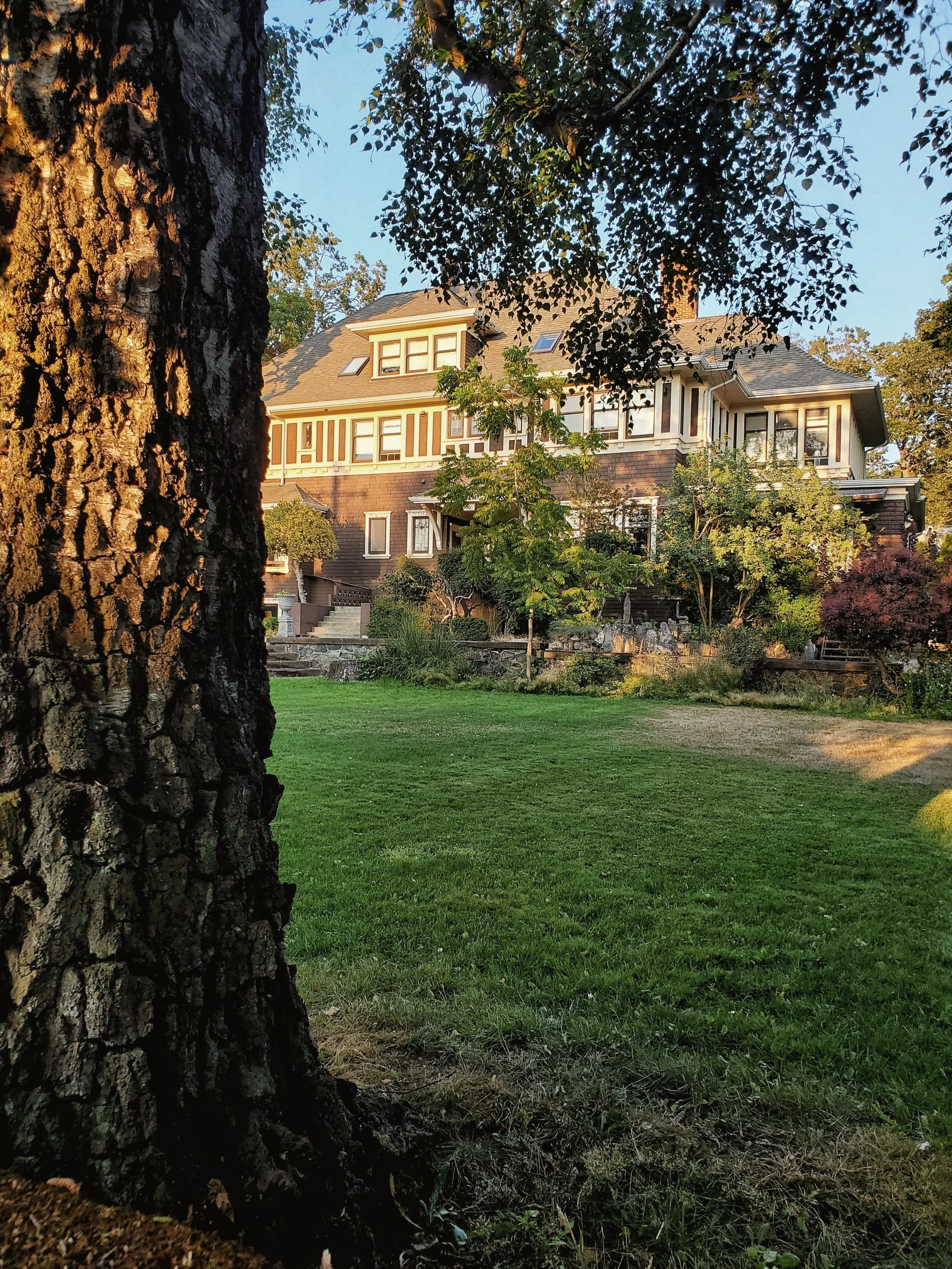
Place & Process
PLACE | CLAIRDENMy work begins with place
In 2021, my beloved and I moved to a suite in a historic mansion originally named Clairden. The house is situated within a remnant Garry Oak ecosystem on the traditional territory of the Lekwungen people. After decades of living in small downtown apartments—and after a year of pandemic restrictions—the garden felt like a world unto itself.
At first, I simply spent time there.
I wandered the grounds. I noticed. I began to recognize the rhythms of the land around me. Fawn lilies appeared under the oaks. Salvia grew in many clusters. Wild cyclamen bloomed and faded. Blossoms gave way to berries, seedheads, and winter silhouettes.
Across the seasons, the plants, trees, birds, squirrels, deer, insects, mosses, lichens, and fungi stopped feeling like scenery and started to feel more like neighbours.
What began as daily hobbles through the garden gradually became a creative practice that deepened my connection to the living world. It reminded me that a life can be geographically small due to chronic illness and still abundant.
The Herbarium grew out of that relationship.
The flowers that appear in my work come primarily from Clairden, my pressing garden, and nearby boulevards. Some are cultivated. Some are native. Some are wildflowers and so-called weeds that are often overlooked.
All of them have been noticed.
And all of them carry a story of place.
PLACE | STUDIOThe studio is where the outside comes in
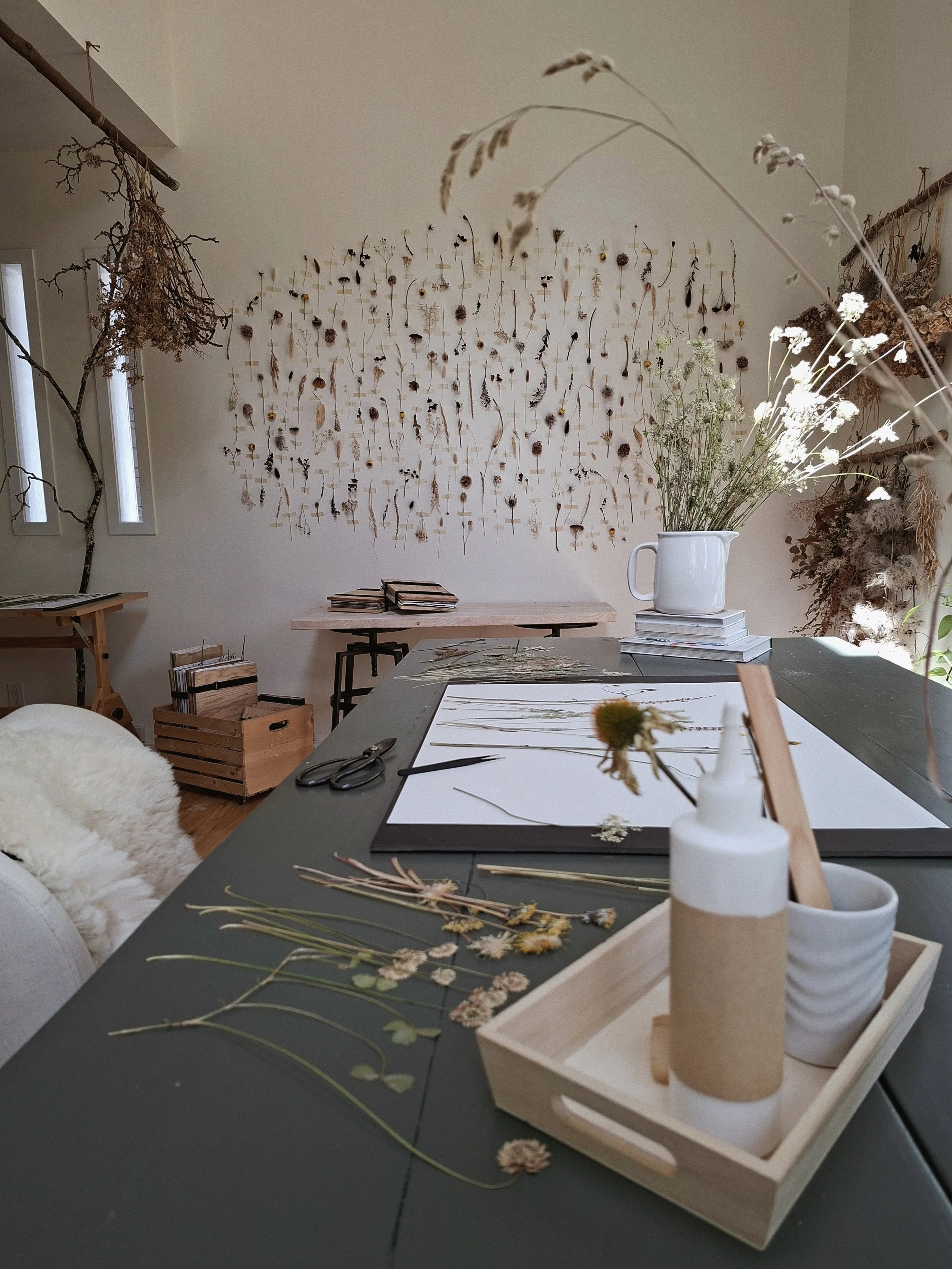
With its large windows, skylight, and door that opens directly into the garden, it's an extension of the landscape beyond it.
Flowers drying in presses. Seedheads waiting to be sorted. Baskets, books, specimens, jars, leaves, grasses, and nature treasures gathered over time. The room is filled with reminders of the living world and the changing seasons.
I think of the studio as another creative opportunity—a place where beauty, attention, and making meet. Everything that enters this room is as aesthetically pleasing, eco-friendly, and cohesive as possible. Does that mean I once spent two hours searching online for a well-designed, wood-handled tabletop brush and cute metal dustpan to sweep my botanical debris into? Yes, yes it does.
PROCESS | ATTENTIONThe work is rooted in relationship, but it starts with attention
Attention is a form of care. So is learning the names and characteristics of plant friends. After all, names are often the starting point in relationships.
Attention also unfolds over time. By noticing the same place season after season, year after year, patterns begin to emerge. Certain flowers arrive each spring. Others linger into autumn. The garden becomes less of a collection of plants and more of a community.
Beauty plays an important role in this practice too. Not just aesthetically, but as a way to deepen the experience of being alive. A bloom in a certain sunbeam, a seedhead, a gorgeous curve of stem, a patch of moss—each becomes an invitation to pause, notice, and remember that we belong to the garden as much as it belongs to us.
The pressed flower work grows from that practice of attention.
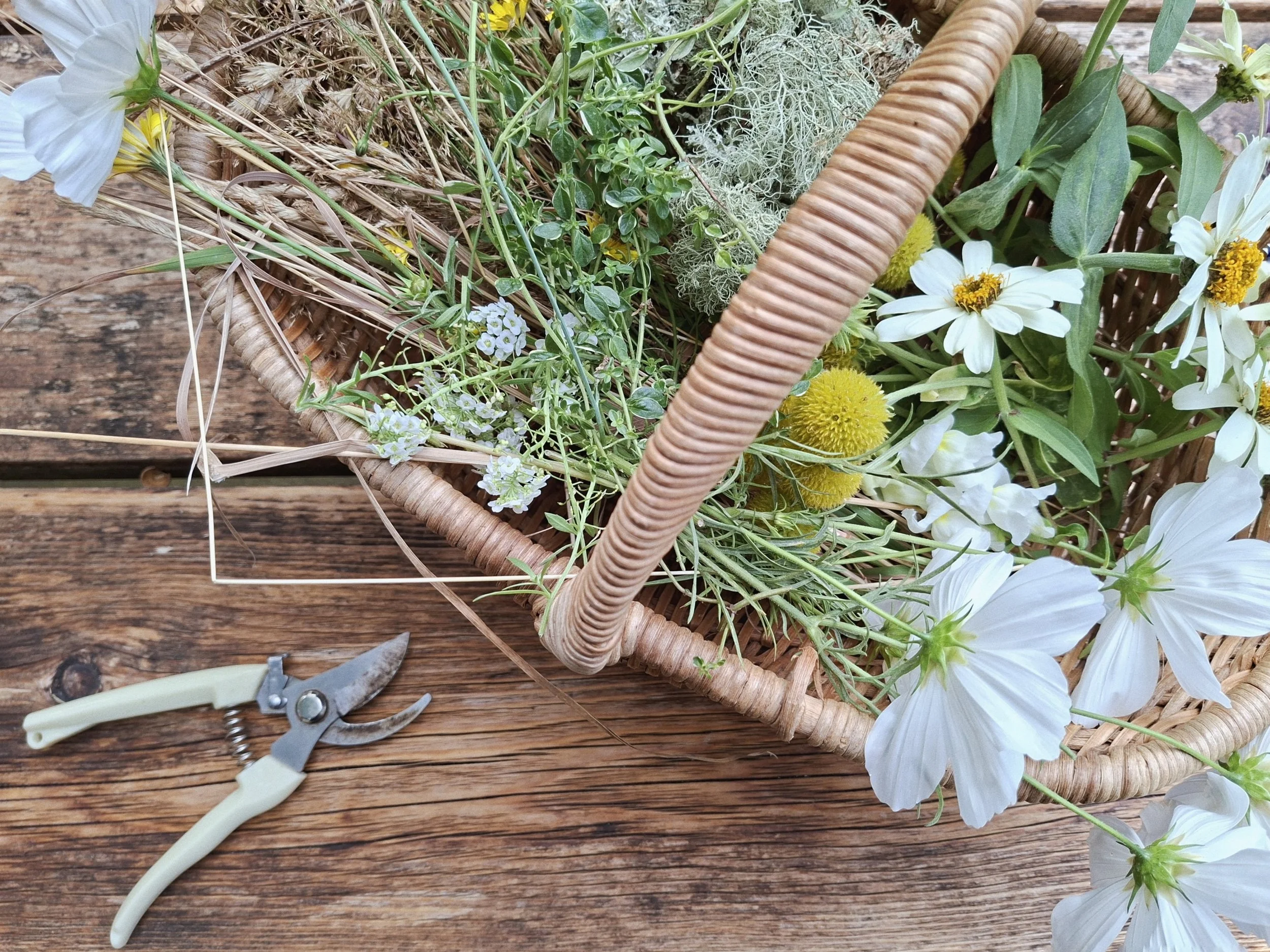
Flowers are gathered only after they've been noticed
MAKING | GATHERINGGathering is done thoughtfully and with care. Before anything is harvested, I've usually spent time with it—watching it emerge, bloom, change, and eventually begin to fade. Some flowers find their way into the presses. Others are left exactly where they are.
The gathering basket is only one small part of a much longer relationship.
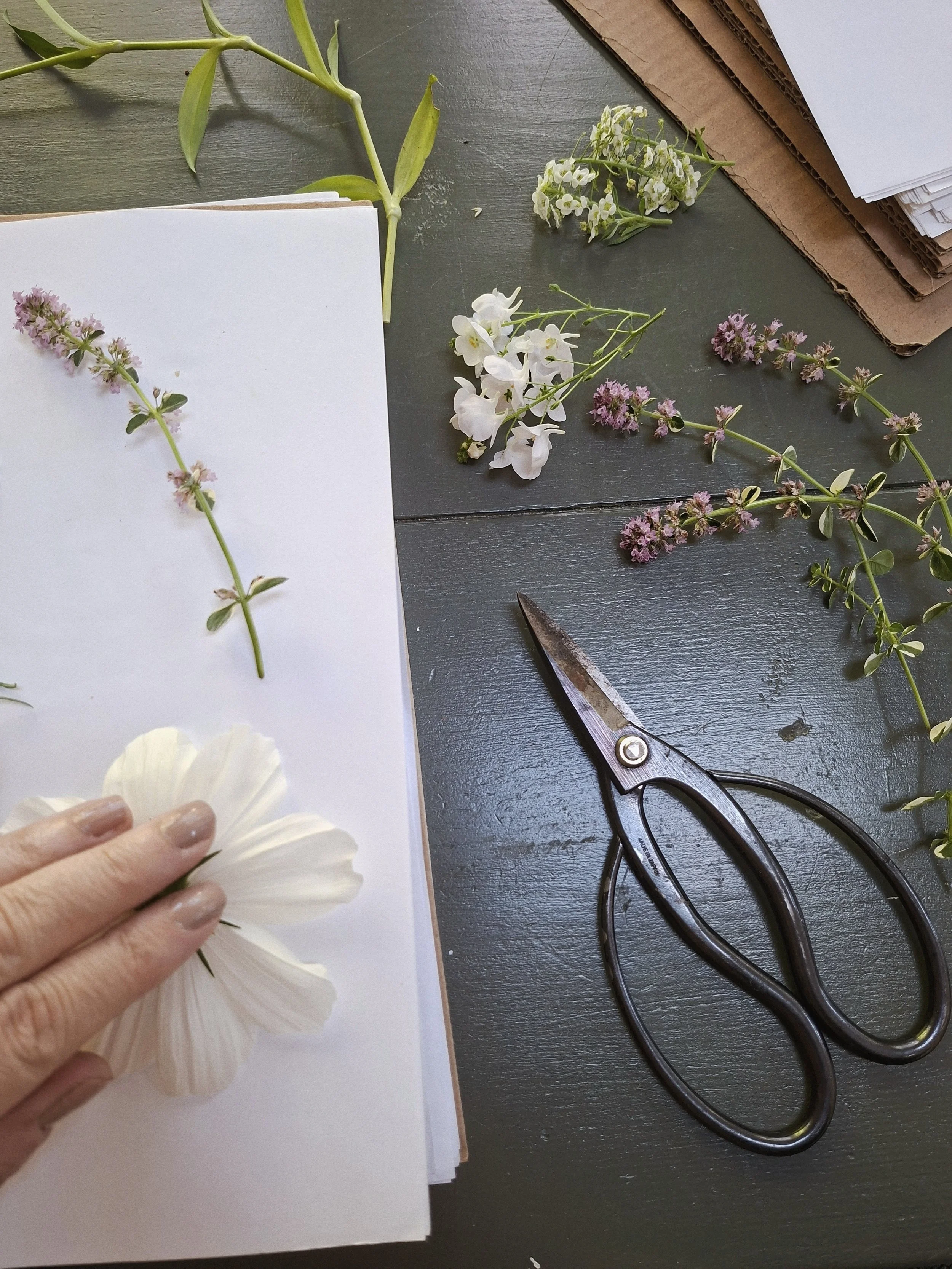
Once gathered, flowers are pressed as soon as possible
MAKING | PRESSINGEach specimen is carefully arranged between layers of paper and cardboard before being tucked into a press. Then comes the waiting.
Over the next several weeks, colour softens, moisture disappears, and something fleeting becomes lasting. Flowers that might otherwise have bloomed for only a few days can be enjoyed for years.
Opening a press is still one of my favourite parts of the process. Even after all this time, there's a little bit of magic in the reveal. Sometimes a flower presses more beautifully than I imagined—like bright orange Oriental poppy petals that fade to pale silk. Sometimes it surprises me in entirely different ways—where did the colour go from that peach-leaved bellflower? And occasionally, despite everyone's best efforts, it becomes compost.
MAKING | CREATINGThe work moves slowly
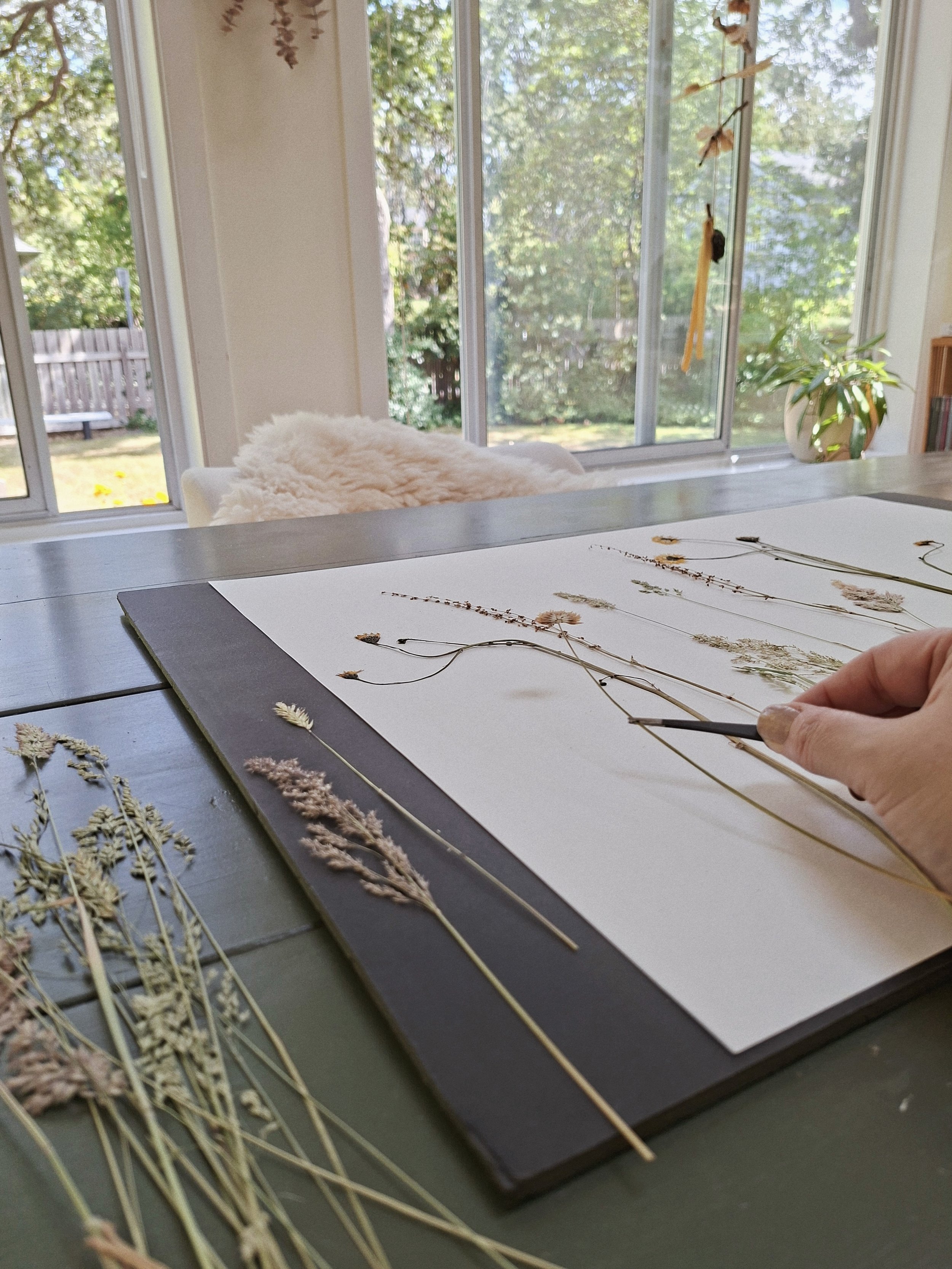
Flowers are gathered, pressed, stored, sorted, arranged, and eventually transformed into specimens and compositions. Some pieces come together quickly. Others spend months—or even years—waiting for the right companion, palette, or composition to emerge.
Some works celebrate a single flower. Others bring many together into a larger gathering.
I usually begin with an idea—a meadow, a season, a colour palette, a flower spell—or simply a desire to spend more time with a particular plant. From there, I experiment. Flowers are moved, swapped, removed, and reintroduced. I take photographs as I go so I can see how a piece is evolving over time.
I'm looking for colour harmony, movement, and fit. The way one stem leans toward another. The way a smaller flower tucks beneath a larger one. The way a collection of plants can feel as though they belong together.
While I often begin with a loose vision, the materials themselves shape the final piece. The flowers in front of me often lead the piece in directions I couldn't have anticipated.
Eventually, after much rearranging, something settles. The piece feels complete enough to be carefully glued into place.
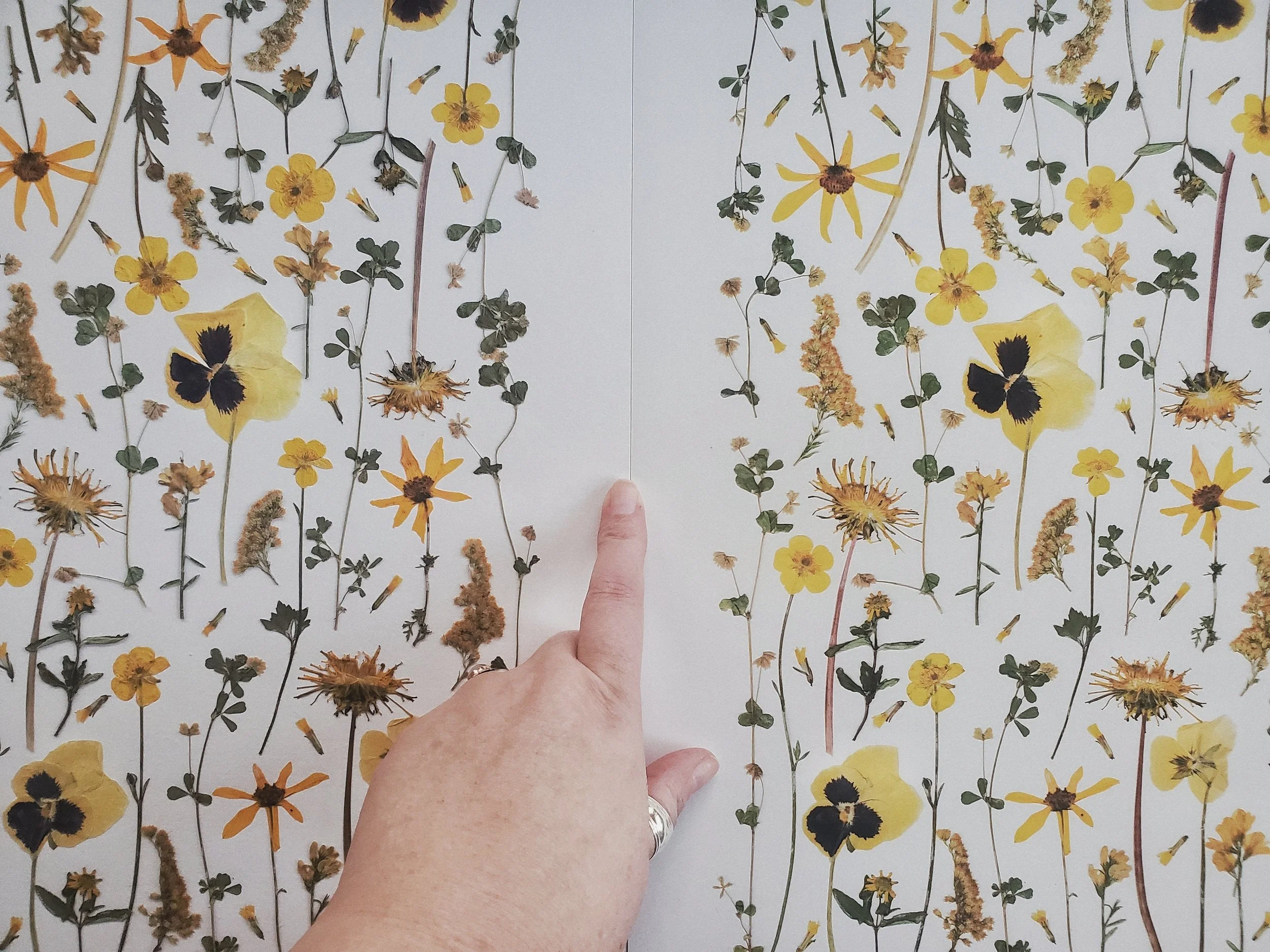
People often ask if they’re looking at an original or a print
MAKING | PRINTSOnce a piece is complete, I work with a trusted graphic professional who handles both scanning and printing with tremendous care. The resulting scans are colour-accurate and detail-rich, capturing even the most delicate shadows, textures, and botanical details.
The prints themselves are archival giclée prints (also called museum-grade prints), produced using fade-resistant pigment inks on heavyweight, 100% cotton, acid-free matte paper.
If you'd like to bring a piece of the garden home, take a look at my available work.